
Webhooks
API credentials let your system ask Knowspread questions. Webhooks are the other direction: the space tells your system when something happens, without being asked.
What webhooks are good for
Section titled “What webhooks are good for”Without a webhook your system has to keep asking: call the API every few minutes and check whether anything changed. It is like walking to the door every so often to see if someone has arrived. A webhook is the doorbell. The space calls you, and only when something has actually happened.
The four events on offer cover the everyday situations companies otherwise handle by hand:
- Training shows up where people already work. An employee is assigned a
mandatory course.
content_assignment_createdarrives and your intranet or calendar creates a task with the deadline. Nobody has to open Knowspread to find out what they have to do. - HR ticks the requirement off by itself. A new colleague finishes safety
training.
content_assignment_completedarrives and the HR system marks the requirement fulfilled. The Friday spreadsheet export and the retyping go away. - A manager hears about a missed deadline the same day. Someone does not
finish assigned content in time.
content_assignment_overduearrives and your system messages their manager in Teams or Slack. Without the webhook, someone would look for it in the completion overview whenever they remembered to. - A test result lands in the register. Someone finishes a test.
test_attempt_completedarrives and your qualification register or audit trail gets the record the moment it happens, not at the next review.
A webhook says that something happened. When your system needs the details, it asks for them through the API with API credentials. The two complement each other: the event is the trigger, the API is the source of detail.
The screen
Section titled “The screen”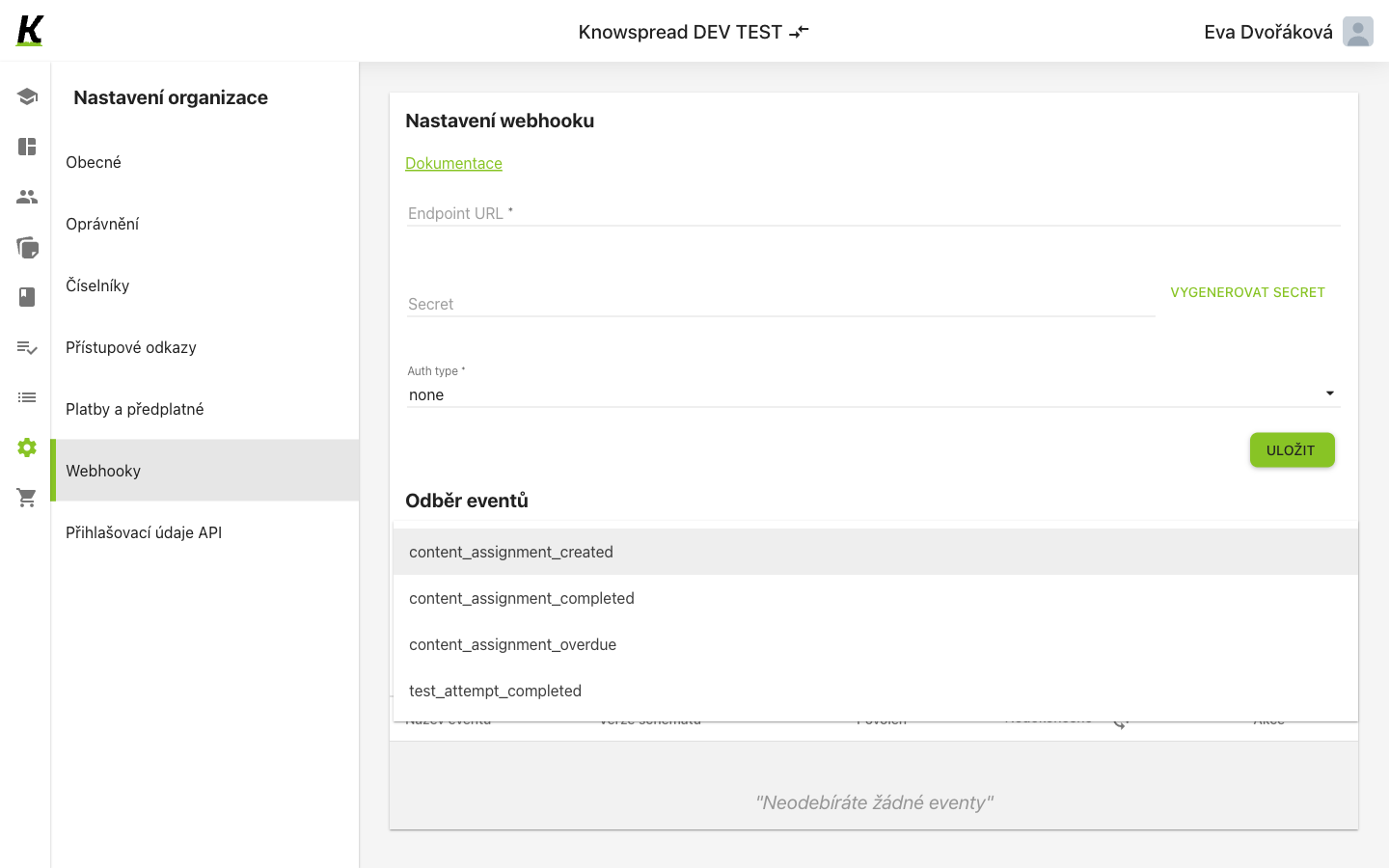
- (1) One endpoint receives everything. You give its URL and a secret — Vygenerovat secret produces one for you.
- (2) Auth type is separate from the secret and defaults to
none. Basic auth credentials appear once you pick it. - (3) Subscriptions are added one event at a time, each with a schema version. Nothing is subscribed by default.
The events on offer
Section titled “The events on offer”The picker offers four events, and they are about assignments and tests rather than about people or content changing.
| Event | Fires when |
|---|---|
content_assignment_created | Content is assigned to someone |
content_assignment_completed | Someone finishes assigned content |
content_assignment_overdue | An assignment passes its deadline |
test_attempt_completed | Someone finishes a test attempt |
Each subscription carries a schema version — v1.0 is what the
version picker offers — so the payload shape is versioned separately from the
event name.
The secret is a signature, not a password
Section titled “The secret is a signature, not a password”Basic auth is separate and optional — it authenticates the call at the transport level, where the secret authenticates the payload.
What to watch for
Section titled “What to watch for”In a personal space this screen draws the form but nothing behind it
is live: webhooks, webhook_settings and webhooks/pending_requests all
answer 403. The subscription section stays empty because it was refused, not
because nothing is subscribed.